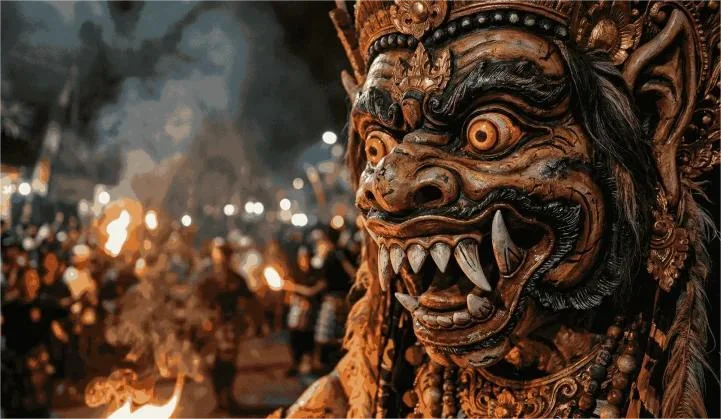
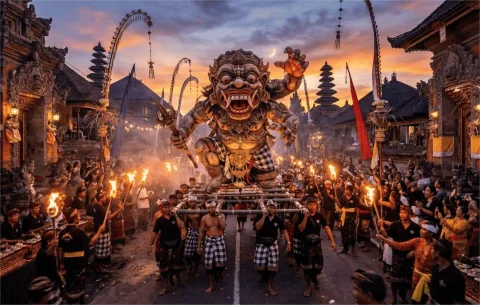
Ogoh-Ogoh are large community-made figures carried in parts of Bali on Pengerupukan, the evening before Nyepi. They are associated with Bhuta Kala and the ritual effort to restore balance before the Day of Silence, while their creation also showcases the work of local youth groups, artists, musicians, and banjar communities. Visitors may be able to watch a procession, but there is no single island-wide parade schedule or fixed public route.
Plan around the specific village or city announcement, not a generic event listing. Confirm the date, gathering point, road closures, photography rules, and return transport close to your visit. The following day is Nyepi, when visitors must remain at their accommodation and normal sightseeing and transport stop.
Ogoh-Ogoh quick facts
| What are Ogoh-Ogoh? | Large sculptural figures created for the period around Nyepi, often representing Bhuta Kala or disruptive forces. |
|---|
| When are they carried? | Commonly on Pengerupukan, the evening before Nyepi; the exact programme is set locally. |
|---|
| Where can visitors watch? | Some banjar, village, district, and city routes welcome spectators, subject to local access and crowd controls. |
|---|
| Is every figure burned? | No single outcome should be assumed. Handling after a procession follows the community's current custom and event arrangements. |
|---|
| What happens next? | Nyepi begins, bringing a day of silence and restrictions across Bali. |
|---|
What Ogoh-Ogoh mean in Balinese tradition
Ogoh-Ogoh are often described as visual forms of Bhuta Kala: forces or qualities that may become disruptive when they are not recognised and brought back into balance. Their dramatic faces and bodies should not be reduced to “monster statues.” They belong to a wider sequence of observances around Tilem Kesanga, Tawur Kesanga, Pengerupukan, and Nyepi.
Bali Province's Ceraken cultural reference on Nyepi explains the relationship between Bhuta Yajña, Pengerupukan, the village procession, and the movement from disruptive force toward harmony. Visitors do not need to claim religious expertise to watch respectfully. It is better to listen to the explanation offered by the host community and avoid presenting one village's practice as a universal rule.
How communities create the figures
Many Ogoh-Ogoh are built collaboratively over weeks by sekaa teruna or yowana youth groups and other community members. The process can involve concept development, structural work, sculpting, painting, costume details, music rehearsal, route planning, and fundraising. Contemporary figures may use inventive mechanics or commentary, but they remain connected to a community and the Nyepi period.
Bali provincial publications describe Ogoh-Ogoh competitions as a way to recognise youth creativity and cultural participation. That community labour is why a preparation space is not automatically a tourist attraction. Ask before entering a banjar work area, touching materials, filming rehearsals, or photographing individuals at close range. If a community accepts a donation, follow its stated process without treating payment as permission for unrestricted access.
What happens on Pengerupukan evening
The sequence differs by place. A neighbourhood may gather, conduct local ceremonies, prepare the carrying platform, and begin only after community leaders decide the route is ready. During a procession, teams manoeuvre a large figure through junctions while baleganjur music, performers, volunteers, residents, traffic officers, and spectators share limited space.
The turning or shaking of a figure can be part of the performance, but spectators should never step into the route for a better photograph. A procession may pause without warning, reverse direction, or change its finish point. Some programmes include judging or staged presentations; others are local processions without a visitor-facing programme.
At the end, figures may be burned, dismantled, retained, displayed, or handled according to current local arrangements. Official descriptions document burning as part of some ritual sequences, while competition rules have also required selected works to be retained. The accurate answer is therefore local and event-specific.
Where to see Ogoh-Ogoh in Bali
Denpasar is often associated with visible public programmes, but it is not Bali's only option. Communities in Badung, Gianyar, and other regencies may organise their own processions or displays. The experience can be equally meaningful near your accommodation, with less cross-island travel before major road restrictions.
There is no permanent “best parade” that can be promised every year. Use this verification order:
- Ask your accommodation which nearby banjar or official programme has confirmed public access.
- Check the relevant city, regency, village, police, or Bali government announcement.
- Confirm the gathering point and route, because the same locality can change its traffic plan.
- Ask when roads are expected to close and when your return vehicle must depart.
- Keep a nearby viewing alternative in case capacity, weather, or ceremony needs alter the plan.
If you stay in Denpasar, nearby daytime context can include Bali Museum, Pura Agung Jagatnatha, Kumbasari Art Market, or a morning near Sanur Beach. Check holiday access and close those visits well before procession traffic begins.
How to plan the evening
Stay close to the route whenever possible. The most common planning mistake is choosing a famous viewing area far from the hotel and assuming a normal return journey. Processions and preparations can close streets, redirect vehicles, and create long pedestrian sections. Nyepi restrictions begin after the evening's observances, so this is not the night for an improvised island transfer.
- Eat early and carry drinking water without creating litter.
- Wear comfortable, respectful clothing and closed or secure footwear.
- Bring minimal valuables and keep phones or cameras attached securely.
- Set a family meeting point in case the group becomes separated.
- Keep children away from the carrying route, torches, sound equipment, and dense crowd edges.
- Agree on the return point and latest pickup time before leaving the accommodation.
A Bali private driver may help with the earlier part of the day, but closures can prevent vehicle access near a parade. Ask whether the driver can legally reach the planned pickup point after closures. For a multi-day plan around Nyepi, use a custom Bali itinerary that leaves the silence day free of transfers and attractions.
Visitor etiquette during a procession
- Follow the banjar and security team. Barriers and instructions take priority over a map or social-media viewing tip.
- Keep the route open. Carrying teams need space to turn, accelerate, stop, and lower the structure.
- Do not touch the figure or platform. It is community work and may be part of an active ritual sequence.
- Ask before close portraits. General crowd photography is different from filming a participant at arm's length.
- Avoid intrusive equipment. Flash, tripods, lights, and raised sticks can distract performers or obstruct others.
- Do not fly a drone without explicit authorisation. Crowd safety, local restrictions, sacred-space considerations, and aviation rules all apply.
- Keep commentary respectful. Do not imitate ritual actions or use demeaning labels for the figures.
Photography without disrupting the event
Choose a stable position at the edge of a permitted spectator area and frame photographs from there. Avoid stepping backward into traffic or holding a phone over a child or participant. A small camera setup is easier to manage than a tripod in a moving crowd. If volunteers ask you to lower equipment or move, respond immediately.
Preparation photographs require extra care because they can show community members, private spaces, or unfinished creative work. Ask a host, accept “no” without negotiation, and credit the community accurately when sharing. Avoid captions that claim a specific symbolic interpretation unless a knowledgeable local source provided it.
Accessibility, children, and sensory needs
Ogoh-Ogoh evenings can involve loud percussion, smoke, darkness, heat, dense crowds, long standing periods, and sudden movement. Travellers with limited mobility, small children, respiratory concerns, or sound sensitivity should ask about a less crowded viewing point or a daytime display. A central junction with the largest audience is not automatically the best choice.
Check walking distance from the last vehicle-access point, surface conditions, toilets, seating, and the possibility of leaving early. Carry hearing protection when appropriate. Never place a wheelchair, stroller, or child on the edge of the procession route, even if the crowd appears stationary.
What visitors must know about Nyepi afterward
Nyepi is not an ordinary public holiday or a wellness event arranged for tourists. It is the Balinese Day of Silence. The traditional observance is associated with restrictions on fire or light, work, travel, and entertainment. Accommodation providers give guests practical instructions that reflect the official rules and their property operations.
Visitors should remain inside their accommodation, limit light and noise, and avoid balconies or outdoor areas when instructed. Normal roads, attractions, and transport do not operate as usual. Indonesia's official tourism site advises travellers that transport hubs close during Nyepi and that current notices must be checked. Read the separate Nyepi visitor guide, then confirm the exact start and end time with your accommodation.
Prepare food, medication, cash, and essential supplies before Pengerupukan traffic begins. Do not schedule a hotel change, tour, airport journey, or boat connection during the silence period. Emergency arrangements exist for genuine needs, but they are not a workaround for sightseeing plans.
How to verify the next Ogoh-Ogoh date
Nyepi follows the Saka calendar, so its Gregorian date changes. Do not reuse the previous year's event poster. First check Indonesia's official holiday decision or the current Bali provincial notice, then look for the local programme. A national holiday date confirms Nyepi; it does not by itself confirm that a particular Ogoh-Ogoh route will run.
The 2026 Bali joint notice is retained here as an example of the authority and detail a current notice should contain, not as a schedule for a future year. For any later trip, replace it with that year's official notice before making transport plans.
Official and cultural references
Frequently asked questions
Is there one main Ogoh-Ogoh parade in Bali?
No. Banjar, villages, districts, and cities may organise different programmes. A prominent Denpasar event does not replace local processions elsewhere, and public access can change each year.
Can tourists watch Ogoh-Ogoh?
Often yes, from permitted public areas. Access is subject to local ceremony needs, route controls, weather, and crowd capacity. Follow the organising community rather than assuming attendance will be possible.
What night is the Ogoh-Ogoh procession?
It is commonly associated with Pengerupukan, the evening before Nyepi. Confirm the current official Nyepi date and the separate local programme because start times and routes vary.
Are Ogoh-Ogoh always burned after the parade?
No universal outcome should be promised. Burning is documented in some ritual descriptions, but communities or competition programmes may retain, display, dismantle, or otherwise handle figures.
Can I travel back to my hotel after the parade?
Only if your route remains accessible before Nyepi restrictions take effect. Arrange the return in advance, expect road closures and walking, and stay near the event whenever possible.